





A dress shirt is the least forgiving garment most men own. The fabric is thin, the fit is close, and it is usually worn in exactly the settings where you care most about how you look: work, weddings, interviews, dates. What you wear underneath decides whether that shirt looks crisp or shows sweat, nipples, chest hair, an undershirt outline, and every contour you would rather it did not. This guide covers the whole question properly: whether to wear an undershirt at all, which style and color actually stay invisible, how to handle sweat, and how to get a flat, smooth line under fitted shirts, including the compression option that solves problems cotton cannot.
Should you wear an undershirt under a dress shirt?
In almost all cases, yes. A dress shirt worn against bare skin absorbs sweat and deodorant directly, which yellows the underarms, shortens the shirt's life, and shows damp patches by mid-afternoon. Thin white and light blue shirts are also more transparent than men realize under office lighting, showing nipples and chest hair clearly. The undershirt exists to solve all of this invisibly. The only common exceptions are heavy or dark shirt fabrics in cool climates, and men who genuinely run cold and never sweat through anything.
Rule one: V-neck when the collar is open
If you wear your top button or two undone, a crew neck undershirt will show at the collar, which instantly reads as underdressed. A V-neck sits below the open collar line and disappears. Check that the V is deep enough for two open buttons if that is how you wear your shirts. With a tie and a fully buttoned collar, a crew neck is fine and adds slightly more coverage.
Rule two: gray or skin tone, never white under white
This is the counterintuitive rule that separates men who know from men who guess. Under a white or light dress shirt, a white undershirt shows as a bright, sharply outlined block, because it contrasts strongly with your skin wherever the undershirt ends. A heather gray undershirt, or one close to your skin tone, blends with your body and vanishes. Save white undershirts for shirts with enough color or weight that nothing shows through anyway. Our full undershirt guide covers the color logic in more detail.
Rule three: fitted, long, and seam-free
An undershirt that billows will bunch at your waistband and print wrinkles through the dress shirt. It should follow your torso closely, run long enough to stay tucked through a day of sitting and reaching, and have flat seams with no chest pocket. Sleeve length matters too: undershirt sleeves should end above the point where your dress shirt sleeve becomes visible when you move.
Handling sweat under a dress shirt
For ordinary days, any fitted undershirt intercepts enough moisture to protect the outer shirt. For real sweaters, fabric choice is the difference: cotton absorbs until saturated and then clings cold and damp, while performance blends wick moisture across a larger area so it evaporates. If your problem is visible underarm rings on the dress shirt itself, the undershirt must have sleeves, which rules out tanks, and a wicking synthetic will serve you far better than cotton. Deodorant residue on dress shirts, the other silent shirt-killer, is also fully solved by any undershirt with sleeves.
The problem cotton cannot solve: the silhouette
Everything above keeps a dress shirt clean and opaque. None of it changes what the shirt reveals about your shape. Dress shirts are cut close through the chest and waist, and thin fabric drapes over whatever is underneath: chest fullness, a soft stomach, loose skin, love handles. A soft cotton undershirt adds a layer without changing the line.
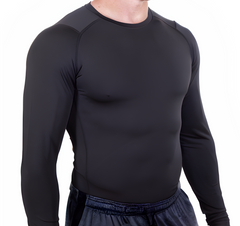
This is where a compression undershirt earns its place in a professional wardrobe. A firm, shapewear-grade compression shirt flattens the chest, holds the stomach, and smooths the sides, so the dress shirt hangs from a clean, even surface. Buttons stop pulling at the belly, the placket sits straight, and the shirt looks the way it did on the fitting-room hanger. For men dealing with chest fullness specifically, whether fat or gynecomastia, this is the single biggest upgrade available for how dress shirts look, and it is completely invisible: modern compression fabric is thinner than a cotton undershirt and has no hardware, so nothing prints through.
Our Original compression shirt is the daily driver here, with firm chest compression in a smooth fabric built to disappear under dress shirts. If the stomach is your main concern, the Ultra slimming shirt provides our strongest hold from chest through lower abdomen. Both run long so they stay tucked, and both are covered in our men's shapewear collection alongside tank options. If you are between sizes, the sizing guide sorts it out in two minutes, and the 30-day free return guarantee covers the exchange if needed.
Putting the layers together, by occasion
- Office, open collar: gray or skin-tone V-neck, fitted, performance fabric. Compression V-neck or crew under the shirt if smoothing matters.
- Suit and tie: crew or V-neck both work under a buttoned collar. Compression is especially worthwhile here since suits telegraph the midsection.
- Wedding, photos, big presentation: this is the day for compression. Cameras and long hours are exactly what it is for.
- Summer and hot venues: wicking synthetic, never cotton, and consider keeping a spare undershirt at the office for all-day events.
- Tuxedo: white tux shirts are often the thinnest of all. Skin-tone or gray underneath, fitted, and compression if you want the cleanest line in photos that last decades.
Care so the system keeps working
Wash undershirts after every wear. Cold water preserves elastic; the dryer destroys it, so hang dry anything with spandex. Rotate 5 to 7 regular undershirts or 2 to 3 compression shirts so each rests between wears. Replace regular undershirts when they yellow or bag out, and compression when the hold softens. Details in the wearing and washing guide.
Frequently asked questions
What should you wear under a dress shirt?
A fitted undershirt in heather gray or your skin tone: V-neck if you wear the collar open, crew or V-neck under a tie. Choose a wicking performance fabric if you sweat, and a firm compression undershirt if you want the shirt to sit flat over the chest and stomach.
Should an undershirt show under a dress shirt?
No, and with the right choices it will not: a V deep enough for your open collar, a color that matches your skin rather than the shirt, a close fit with flat seams and no pocket, and sleeves short enough to stay hidden.
What color undershirt is best under a white dress shirt?
Heather gray or a tone close to your skin. White under white creates a visible outline because it contrasts with your skin at the edges, while gray and skin tones blend and disappear.
How do I keep sweat from showing through my dress shirt?
Wear a fitted undershirt with sleeves in a moisture-wicking fabric, which intercepts sweat and spreads it to dry before it reaches the outer shirt. Cotton works for light sweat but clings once saturated.
Can you wear a compression shirt under a dress shirt?
Yes, and it is one of the best uses for one. Quality compression undershirts are thinner than cotton undershirts, have no visible seams or hardware, and flatten the chest and stomach so the dress shirt drapes cleanly. Nobody can tell you are wearing one.
Do compression shirts work under a suit?
Very well. Suits are fitted through the torso, so smoothing the layer underneath improves how both the shirt and the jacket sit, particularly through the midsection, for long formal days like weddings and conferences.
Tank top or T-shirt undershirt under a dress shirt?
A T-shirt style with sleeves protects the underarms of the dress shirt from sweat and deodorant, which is most of the point, so it is the default. A tank works when heat is the priority and underarm protection does not matter, or when torso smoothing is the only goal.
The bottom line
Gray or skin tone, V-neck for open collars, fitted and long, wicking fabric if you sweat, and compression when you want the shirt to sit flat instead of merely staying clean. The full undershirt landscape is in our complete undershirt guide, and the smoothing layer that upgrades every dress shirt in your closet starts with the Original compression shirt in the men's shapewear collection.


