
Este sitio web tiene ciertas restriucciones de navegación. Le recomendamos utilizar buscadores como: Edge, Chrome, Safari o Firefox.

Cambios de talla gratuitos Devoluciones gratuitas

Carro 0

No hay más productos disponibles para comprar

Productos

Par con

¿Es esto un regalo?

Ships in discreet packaging

Costo sin impuestos Gratis
Antes de los impuestos y gastos de envío.
Esteem Apparel “How to Stop Dreading Photos” blog banner featuring a light photography-themed layout with a camera, printed photos, and confidence tips for looking and feeling better in pictures.

How to Stop Dreading Photos

There is a specific moment a lot of men know well. Someone lifts a phone, the group leans in, and you do the calculation. Where to stand. Which side. Whether to be in it at all.

Then the photo appears in a group chat two days later and confirms everything you suspected.

Here is the thing worth knowing: a large part of what you are reacting to in that photo is not you. It is the camera. Phone cameras are wide-angle lenses held close, and wide-angle lenses at close range distort whatever is nearest to them and flatten everything behind it. Almost nobody is photographed under conditions designed to be flattering. You are comparing your worst lighting and a bad lens against other people's chosen, filtered, tenth-attempt images.

That does not make the feeling go away. But there are about six things that genuinely change how you come out, and they are all free.

1. Get the camera to eye level or above

This is the biggest single factor and it is not close.

A camera held at chest height shoots up at you. Shooting up compresses the neck, widens the jaw and the midsection, and makes everyone look heavier and shorter. A camera at or slightly above eye level does the opposite.

You cannot always control who is holding the phone. You can say "can you lift it a bit?" and most people will, because it makes them look better too. If you are the one taking it, hold it higher than feels natural.

2. Stop standing square to the lens

Facing the camera straight on presents your widest possible outline. It is the single least flattering angle available to anyone of any size.

Turn your body about thirty to forty-five degrees away, then bring your face back toward the lens. Your shoulders now read as a narrower line, and you get some depth instead of a flat rectangle. Put your weight on the back foot.

This is what every actor on a red carpet is doing. It is not a trick reserved for them.

3. Chin forward and slightly down

Counterintuitive, and it feels ridiculous while you do it.

The instinct is to lift your chin, which stretches the neck and shows the underside of the jaw. Wrong direction. Instead push your forehead slightly toward the camera and drop your chin a fraction. This tightens the skin under the jaw and gives you a jawline instead of a slope.

It feels like you are sticking your head out like a turtle. On camera it reads as a defined jaw. Try it once in a mirror and you will see the difference immediately.

4. Give your hands a job

Arms hanging straight down press flat against your sides and make your torso look wider. Arms crossed tight across the chest do the same and read as closed off.

Better: a hand in a pocket with the thumb out, a drink held at waist height, a hand on the back of a chair, an arm around whoever is next to you. Any of these puts a small gap of light between your arm and your body, which visually narrows the whole outline.

5. Breathe out, and talk right before the shutter

Holding your breath and sucking in creates a very specific frozen look that everyone recognizes and nobody likes. Breathe out slowly instead. Shoulders drop, the face relaxes.

For the expression itself: say something. Anything. A real smile involves the eyes and it is almost impossible to produce on command from a standing start, but it happens naturally about half a second after you speak. The good photo is usually the one taken while someone was mid-sentence, which is why candids beat posed shots so reliably.

If you have to hold a smile, push your tongue against the roof of your mouth. It stops the smile spreading too wide and softens the whole thing.

6. Choose where you stand

Front row and center of a group shot is the worst position, because you are closest to the lens and getting the most distortion. Slightly back and toward the edge, angled inward, is better in almost every case.

Light matters too. Light from above and slightly in front is kind. Overhead fluorescent strips and direct midday sun are not, because they carve shadows straight down and exaggerate everything.

The part that matters more than any of this

Every tip above is worth knowing. None of them is the actual problem.

The actual problem is that scanning a photo for what is wrong with you takes attention away from the thing the photo was about. There is a decent amount of psychological research on what is called the spotlight effect: people consistently and dramatically overestimate how much others notice and remember about their appearance. The finding is remarkably stable. Other people are running the same anxious internal monologue about themselves, and they have very little attention left over for you.

What people do remember is how a conversation with you felt. Whether you were present. Whether you seemed like you wanted to be there. That is not a consolation prize, it is the thing that actually builds friendships, working relationships and everything else. The man who is half-absent because he is managing how he looks is a worse conversation than the man who is not, regardless of what either of them looks like.

Which is the real argument for sorting out the thing that distracts you. Not because your appearance is the point, but because being finished worrying about it frees up the attention for everything that is.

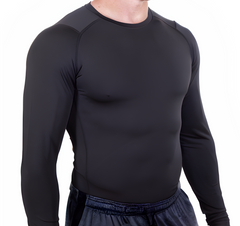
That is what a compression shirt is for. It is not a transformation. It is a clean line under your shirt so that the question is settled before you leave the house and you are not checking your reflection in every window on the way. Most men tell us the difference is not how they look in the photo. It is that they stopped angling away from the camera.

The Gynecomastia Compression Shirt is the firmest option and the one most men start with. The Max tank covers the torso if you want the whole line smoothed rather than the chest alone.

Discreet packaging on every order, and free size swaps if the first one is not right.

Related reading

See the full range

Lecturas adicionales