Este sitio web tiene ciertas restriucciones de navegación. Le recomendamos utilizar buscadores como: Edge, Chrome, Safari o Firefox.

Cambios de talla gratuitos Devoluciones gratuitas

Carro 0

No hay más productos disponibles para comprar

Productos

Par con

¿Es esto un regalo?

Ships in discreet packaging

Costo sin impuestos Gratis
Antes de los impuestos y gastos de envío.
Esteem Apparel style guide for bigger men with smart fit and outfit tips.

Dressing Well When You Are Built Bigger: Office and Events

Most style advice for bigger men is either useless or actively wrong. "Wear vertical stripes" is the classic example: it is repeated everywhere, and it does almost nothing compared to the things that actually matter.

What matters is fit, fabric and where the eye lands. Get those three right and the clothes do the work. Here is how that plays out for an office, a wedding, a work dinner, or anywhere you need to look put together.

Fit: one measurement decides everything

The shoulder seam. That is it.

On a jacket, shirt or coat, the seam where the sleeve joins the body should sit on the outside corner of your shoulder. Not past it, not inside it. Everything else on a garment can be altered by a tailor for very little money. The shoulder cannot, or not without serious cost.

So: buy for the shoulders, then have the rest taken in. A shirt bought two sizes up so it is loose across the middle will have shoulder seams hanging halfway down your arms, and that reads as sloppy in a way people notice without knowing why. A jacket that fits the shoulders and has been taken in slightly at the waist reads as tailored even if it cost very little.

The mistake almost everyone makes

Sizing up to hide. It backfires. Excess fabric does not conceal shape, it adds volume, and volume is the thing you were trying to avoid. A garment that skims is smaller than the one most men reach for.

Skims, not clings. There is a real difference and it is mostly about fabric.

Fabric: weight and drape beat everything else

This is the part almost nobody talks about, and it is more important than color or pattern.

Thin, stretchy, clingy fabrics follow the body exactly. Cheap jersey, thin polyester blends, lightweight fitted knits. They show every contour, which is why a plain t-shirt can feel worse than a dress shirt even though it is more casual.

Fabrics with weight and structure hang from the shoulders and fall in a straight line. They create their own silhouette instead of borrowing yours.

  • Good: oxford cloth, twill, heavier cotton poplin, flannel, wool and wool blends, linen blends with some body, structured knits.
  • Avoid: thin jersey, shiny satin or sateen, clingy performance polyester, very thin merino, anything that shows a crease when you pinch it.

Texture also helps. A matte or slightly textured surface scatters light. A shiny surface reflects it in bright patches, and bright patches are exactly where the eye goes.

Color: keep the torso quiet

The rule is not "wear black." Black is fine but it is not magic, and a lot of black outfits look severe rather than sharp.

The useful principle is tonal continuity through the middle. A single uninterrupted color from shoulder to hip reads as one long line. Break it with a contrasting belt, a light shirt against dark trousers, or a bright horizontal element, and you cut that line in half.

Practical version:

  • Darker or mid-tone on the torso, and keep the shirt and trousers in a similar depth of color if you can.
  • Put the interesting color near your face. A tie, a pocket square, a knit collar. It pulls the eye up.
  • Navy, charcoal, olive and deep brown all work as well as black and look less like a uniform.

The jacket, specifically

A jacket is the most useful thing in the wardrobe for this, because it does three things at once: adds structure at the shoulders, creates a vertical line down each side of the torso, and hides the waistband.

A few points that matter:

  • Button the top button only on a two-button jacket, and never the bottom one. The bottom button is what pulls a jacket into an X shape across the middle.
  • Check the button does not strain. If there are horizontal pull lines radiating from it, the jacket is too tight through the body and it is drawing attention to exactly that spot. Half a size up, or have the button moved.
  • Length matters. A jacket that ends too short makes the torso look longer relative to the legs. It should cover your seat.
  • Notch lapels of moderate width are the safe choice. Very narrow lapels make the chest look broader by comparison.

If a jacket is too formal for your office, a structured overshirt or an unlined blazer does most of the same work.

Shirts and collars

Collar first: a spread or semi-spread collar sits better than a narrow point collar, which can look small and make the face and neck look wider by contrast.

Then the details that quietly cause problems:

  • Chest pockets. A patch pocket sits right on the part of the chest you would rather not draw a box around. Plain fronts are better.
  • Placket gape. If the buttons pull between the third and fourth button, the shirt is too tight through the chest, and that gape is far more noticeable than a slightly looser shirt would be.
  • Tuck or do not tuck, but decide. A half-tuck or a shirt that keeps coming untucked looks unconsidered. If it is a dress shirt, tuck it properly and use a shirt stay if it rides up.
  • Sleeve length. Ending at the wrist bone. Long sleeves bunching over the hand make everything look oversized.

The base layer nobody mentions

Here is the gap in most style advice: it treats the shirt as the first layer.

It is not. What is underneath decides how the shirt sits. A dress shirt over nothing follows whatever is under it. A dress shirt over a smooth, flat base layer has a surface to fall against, which is why the same shirt can look completely different on two different days.

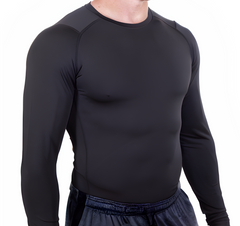
This is the actual reason a compression base layer belongs in a section about dressing well rather than in a section about shapewear. It is a foundation garment in the plain sense: it gives the outer layer something even to hang from. It also solves the summer version of the problem, where a second layer for coverage means being too hot, because a thin compression layer is one layer rather than two.

For a dress shirt, the EliteSlim is the one to reach for, because it is thin enough to disappear under formal cotton. For a heavier build or a fuller day, the Gynecomastia Compression Shirt holds firmer. If you want the whole torso smoothed rather than the chest alone, the Max tank does that.

What to skip entirely

  • Horizontal chest stripes and large chest graphics.
  • Shiny fabrics anywhere on the torso.
  • Very thin knitwear worn on its own.
  • Oversized anything, on the theory that bigger hides more. It does not.
  • Double-breasted jackets unless you already know they work on you.

The short version

Buy for the shoulders and alter the rest. Choose fabric with weight. Keep the torso one color and put the interest near your face. Sort out the layer underneath before you blame the shirt.

None of it is about hiding. It is about not spending the evening thinking about your clothes.

Every order ships in discreet packaging, and size swaps are free.

Related reading

See the full range

Lecturas adicionales