



This article is about comfort and clothing choice, not medical treatment. Nothing here diagnoses or treats anything. If you or someone in your family is exploring deep-pressure input for autism, ADHD, anxiety or sensory-processing differences, an occupational therapist is the right professional to guide that, and we would rather you talk to one than take a clothing brand's word for it.
What deep pressure actually is
Ask men why they keep wearing a compression shirt long after the reason they bought it stopped mattering, and the same answer comes back: it just feels right.
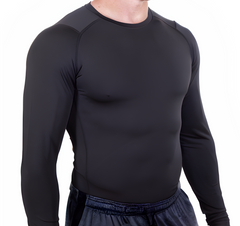
There is a name for the thing they are describing. Steady, evenly distributed pressure across the body is usually called deep pressure, or deep touch pressure. It is the same category of sensation as a weighted blanket, a firm hug, or the swaddling that settles a newborn. A compression shirt delivers a mild, constant version of it across the torso, for as long as you wear it, without anyone being able to tell you are wearing anything.
People differ enormously in how they respond. Some find snug clothing irritating and always will. Others actively seek firm pressure out and find loose fabric shifting around them far more distracting than a close layer. Most men sit somewhere in between and simply notice they feel a bit more held together with one on.
What the research shows, and what it does not
We are going to be straighter with you here than most of the pages you will find on this subject.
The idea entered mainstream awareness through Temple Grandin's work in the 1990s on a squeeze machine she designed for herself. Since then, deep touch pressure has been studied mostly through weighted vests and similar tools, in small studies, largely with children, in school settings.
The results have not been kind to the strong claims. A 2016 meta-analysis by Losinski, Sanders and Wiseman, Examining the Use of Deep Touch Pressure to Improve the Educational Performance of Students With Disabilities, reviewed the available studies against formal evidence standards and concluded that deep touch pressure interventions "are of generally poor quality and demonstrate effects that do not validate their current use for students with disabilities."
That is a real finding and we are not going to hide it. If a company tells you a compression shirt is a proven therapy for autism, anxiety or sensory processing, that company is ahead of the evidence.
Here is what is not in dispute. A great many people reliably prefer firm, even pressure. They notice when they have it and they notice when they do not. That preference is real, it is consistent, and it is a perfectly good reason to choose what you wear. It is a comfort fact rather than a clinical one, and it does not need to be a clinical one to matter to your day.
So the honest framing is this. A compression shirt is not a treatment and we make no medical claims for it. If firm pressure is something you find comfortable, it is a socially invisible way to have that comfort all day, under a work shirt, in a meeting, on a plane.
What men tell us
- A settled, grounded feeling on difficult days. A number of customers describe wearing theirs deliberately before presentations and hard meetings.
- Less fabric noise. No loose material shifting, no seams wandering, no cuff or hem to keep adjusting.
- A consistent sense of where their body is. The constant light pressure gives ongoing feedback, which some people find focusing.
- It becomes routine. Men who wear compression daily often say a day without it feels off, in the way a day without a morning routine does.
An important thing about sizes
We make compression shirts for adult men, in sizes Small through 3XL depending on the style. We do not make children's sizes and we are not going to pretend our smallest size fits a child.
We say this plainly because a lot of people arrive at this page looking for a compression garment for a child, and sending them in circles helps nobody. If that is you, two things are worth knowing. First, an occupational therapist can assess whether deep pressure is useful for your child specifically and can recommend purpose-made tools, which matters more than any brand recommendation. Second, several companies make sensory clothing designed and sized for children, and they are the right place to look. That is genuinely outside what we do.
What we do make is the thing that is oddly hard to find: a compression layer for a grown man that looks like an ordinary undershirt. Most sensory-focused compression on the market is designed for children, or is a visible vest worn over clothing. If you are an adult who wants firm even pressure and also wants to wear a normal shirt to work, that gap is what these are for.
Choosing for sensory comfort, not for shaping
Most compression shirt advice assumes you are buying to flatten your chest or stomach. If you are buying for comfort, the priorities change.
Seams and labels come first
For a lot of people this decides everything. A scratchy label at the back of the neck or a raised seam under the arm will make an otherwise perfect shirt unwearable. When you are comparing any brand, this is the specification to ask about before you ask about compression strength. Our shirts are designed to sit invisibly under clothing with no visible seams or lines, which is a different question from how a seam feels against skin, so if you are highly seam-sensitive it is worth trying one before committing to three.
Even pressure beats maximum pressure
The goal is uniform, and uniform is not the same as tight. Pressure that is firm across the whole torso feels calm. Pressure that concentrates at the shoulders, the hem or the sleeve edge feels like being pinched, and pinching is the opposite of what you came for. This is why sizing down is a mistake, which is worth its own section below.
Think about heat
An extra close-fitting layer is an extra layer. If you run warm, or if temperature is itself a sensory issue for you, a lighter shirt or a sleeveless tank is often the more wearable choice even though it gives less coverage.
Think about edges
Some people are fine with all-over pressure but cannot tolerate the sensation of a sleeve edge on the bicep. If that is you, a tank removes the problem entirely.
Buy more than one
If a shirt works for you it will become part of getting dressed, which means it needs to be in the wash sometimes. Most people who buy one for comfort end up buying more.
Which one
| Shirt | Pressure | Sizes | 1-pack | 3-pack | Best for |
|---|---|---|---|---|---|
| EliteSlim | Firm but even | M to 3XL | $24.99 | $62.99 | The default pick for sensory comfort. Even distribution, designed to be invisible under a shirt. |
| UltraSlim | Medium | S to XL only | $16.99 | $42.99 | Anyone easing into compression, or who wants something closest to a familiar t-shirt feel. |
| Original | Firm to extra tight | M to 3XL | $29.99 | $74.99 | People who want the most input and know they like firm pressure. |
| Max Tank | Maximum | M to 3XL | $26.99 | $71.99 | Sleeveless. The answer if sleeve edges bother you or you overheat easily. |
Note the UltraSlim stops at XL. If you are above that, your choice is between the EliteSlim, the Original and the Max Tank.
Do not size down
This is the most common mistake and it matters more here than anywhere else on this site.
People reason that if firm pressure feels good, firmer pressure will feel better, and order a size below their measurement. What actually happens is that the fabric stops distributing evenly. It bunches, it rides up, it digs in at the shoulders and the hem, and the even all-over sensation you were buying disappears and is replaced by several sharp ones. It is also the main reason compression shirts get abandoned in a drawer.
Order your measured size using the size guide. If you want more input than your measured size gives you, move up a model rather than down a size.
One practical tip when putting it on: step into the shirt and pull it up gradually rather than dragging it on over your head. The fabric settles evenly that way, and evenly is the whole point.
Who this is not for
If snug clothing genuinely bothers you, believe that about yourself. Sensory preferences are real and personal, and there is no version of a compression shirt that is going to feel good to someone who does not like being held. Compression is a preference, not a virtue.
It is worth separating two things, though. A too-small regular shirt and a correctly sized compression shirt are very different sensations, and some people who assume they hate compression have only ever experienced the first one. If you are unsure, the UltraSlim in your measured size is the gentlest place to find out.
FAQs
Do compression shirts help with autism?
We cannot claim that and we will not. Compression shirts are clothing, not therapy, and the research on deep touch pressure as a clinical intervention is weak. What is true is that many autistic people describe firm, even pressure as calming and seek it out. If that describes you, a compression shirt is a discreet way to have that sensation through the day. If you are considering deep pressure therapeutically, speak to an occupational therapist.
Is this the same as a weighted blanket?
Same family of sensation, different delivery. A weighted blanket uses weight while you are still. A compression shirt uses fabric tension while you move around. People who like one often like the other, though not always.
Can compression clothing help with anxiety?
We do not claim that either. What is well established is that a lot of people experience firm even pressure as calming, and some men choose to wear compression on stressful days for that reason. If anxiety is affecting your life, that is a conversation for a doctor or therapist. Clothing is comfort, not treatment.
Do you make compression shirts for children?
No. Our smallest size is Small in adult men's, and most styles start at Medium. We would rather tell you that than sell you something that does not fit. For a child, start with an occupational therapist, then look at brands that design and size specifically for children.
How long can I wear one?
Ours are designed as everyday undershirts and most customers wear them for a full day. That is a comfort answer, not a medical one. If you have a circulatory condition, a skin condition, or you are recovering from surgery, ask your doctor before wearing compression for long stretches.
Which one gives the most even, least pinchy pressure?
In your correctly measured size, the EliteSlim. Pinching almost always comes from sizing down rather than from the shirt itself.
Will it be obvious I am wearing it?
No. These are undershirts and they are designed to disappear under a normal shirt. That is most of the point, and it is the main practical difference between a compression shirt and a sensory vest worn over clothing.
I run hot. Is compression a bad idea?
It is an extra layer, so it will be warmer than nothing. If heat is the issue, the Max Tank removes the sleeves and a good deal of the fabric, and lighter colours help under thin shirts.
What size do I order?
Your measured size, from the size guide. Not one below it.
What if it does not work for me?
Sensory preference is individual and you will not know until you try. See our exchanges and returns page for how that works.


