





This article is for general information only and is not medical advice. If you think you have diastasis recti, or you have abdominal pain, a visible bulge, or core weakness, speak with your doctor or a physical therapist.
What is diastasis recti?
Diastasis recti is a separation of the rectus abdominis — the paired "six-pack" muscles that run down the front of your stomach. The two sides are joined in the middle by a band of connective tissue called the linea alba. When that tissue stretches and thins, the muscles drift apart, leaving a gap you can sometimes see as a ridge or bulge down the midline, especially when you sit up or strain.
It's often talked about as a postpartum condition, but men get diastasis recti too. In men it's most commonly linked to carrying weight around the midsection, repeated heavy lifting with poor bracing technique, chronic straining, yo-yo dieting, and simple age-related tissue change. The telltale signs are a vertical bulge or "doming" down the centre of the stomach when you crunch or cough, a belly that protrudes no matter how much weight you lose, and a core that feels weak or unsupported.
How is it treated?
To be clear up front: no shirt fixes diastasis recti. The gap itself responds to targeted core rehabilitation — exercises that retrain the deep transverse abdominis and teach the core to brace properly — and in severe cases to surgical repair. A physical therapist can measure the separation and build a programme around it, and that should be the foundation of any plan.
Where compression fits in
What a good compression shirt can do sits alongside that rehab work, and it's genuinely useful:
- External support. Firm, even compression around the midsection acts like a gentle brace, supporting the abdominal wall so everyday movement — standing, walking, lifting the shopping — feels more stable and less fatiguing.
- A flatter profile under clothes. The midline bulge is what bothers many men most. Compression smooths it immediately, so shirts sit cleaner while you work on the underlying muscle.
- Postural feedback. Compression through the torso encourages you to stand taller and engage your core rather than letting the stomach hang forward — a small, constant reminder that complements rehab exercises.
- Confidence while you rehab. Core rehabilitation takes months. A compression layer lets you feel like yourself in the meantime.
One important caution: compression should support, never dig in. Painfully tight garments and hard waist-cinchers can raise intra-abdominal pressure, which is exactly what a separated midline doesn't need. Choose firm-but-comfortable, and take it off if anything hurts.
Which Esteem shirt should you choose?
For diastasis recti, most men do well with the Max Compression Tank Top. It delivers strong compression through the torso in a cooler, sleeveless layer you can comfortably keep on all day — including under work clothes — and the longer cut stays anchored over the lower stomach instead of riding up above the separation.
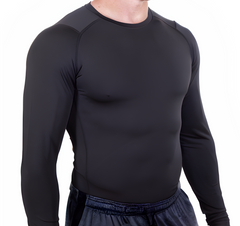
If you want the firmest all-over hold, including through the stomach and sides, the Original Compression Shirt is the tightest garment we make across the entire upper body. Some men rotate both: the Original on days they want maximum support, the Max Tank for warm days and long wear.
Whichever you choose, fit matters more than model. Measure and match your size to our size guide — with diastasis recti you want firm, comfortable support, not the smallest size you can squeeze into. Exchanges are always free if the first size isn't right.
Diastasis recti FAQs
Can a compression shirt heal diastasis recti?
No. Compression supports the abdominal wall and improves how you look and feel day to day, but closing the gap requires targeted core rehabilitation, guided by a physical therapist, and occasionally surgery. Think of compression as a supportive companion to treatment, not the treatment itself.
How do I check if I have it?
Lie on your back with knees bent, lift your head slightly, and press two fingers just above and below your belly button along the midline. A gap of roughly two finger-widths or more, or visible doming when you crunch, is worth having assessed properly by a doctor or physical therapist.
Can I wear compression while exercising?
Our shirts are designed for daily wear and low-impact activity. During dedicated core rehab sessions, many therapists prefer you train without compression so the deep muscles learn to do the work themselves — ask yours what they recommend.
How tight should compression be for diastasis recti?
Snug and supportive, never painful. If a garment digs in, restricts breathing, or leaves deep marks, it is too tight and may increase pressure on the midline. Order your measured size from the size chart.


